
In over 25 years of working in financing, advisory, and real estate, we have reviewed hundreds of construction projects, from small multi unit builds to large commercial developments.
And here is the reality that most people do not want to hear:
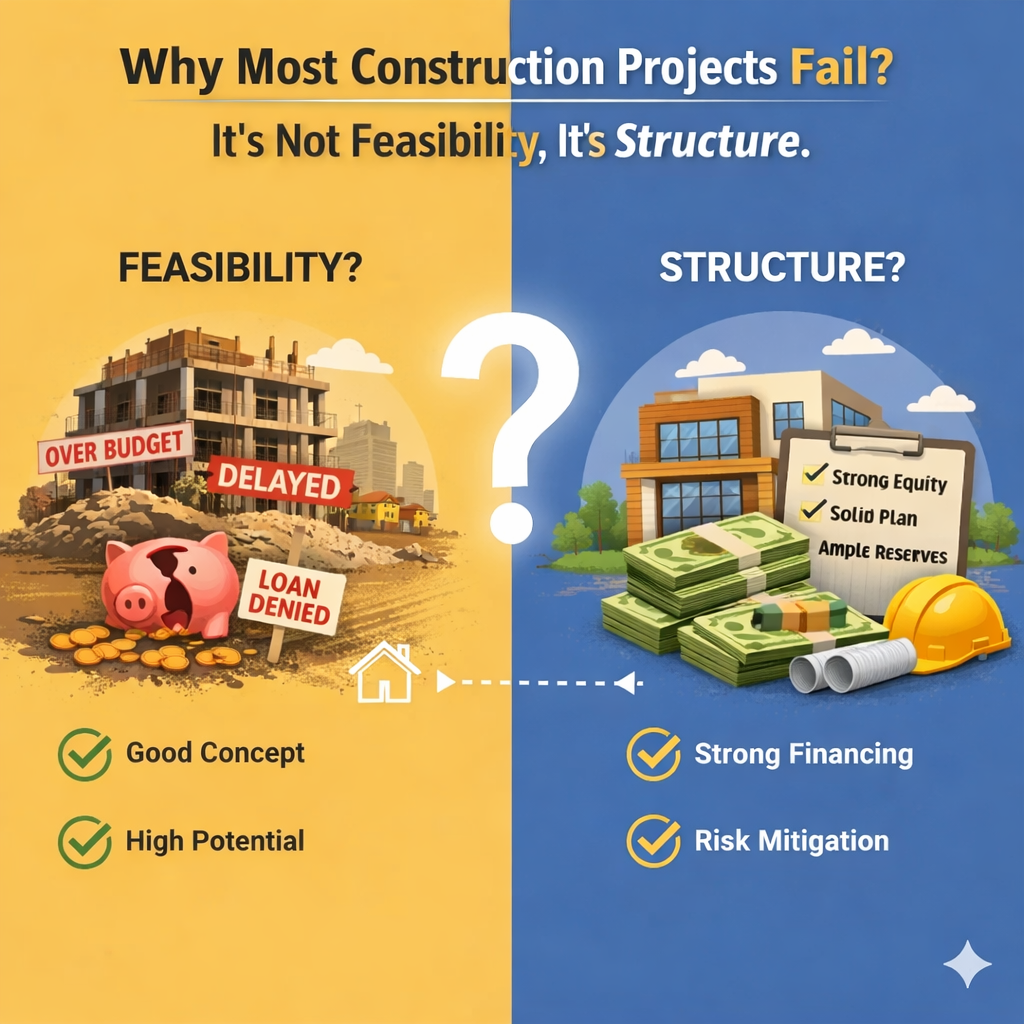
Most construction projects do not fail because they are bad ideas. They fail because they are poorly structured.
That distinction matters.
Because a project can be profitable, well located, and in demand, and still never get off the ground.
Why?
Because without the right financial structure, there is no financing.
And without financing, there is no project. End of story.
Feasibility versus structure is one of the most misunderstood gaps in real estate development.
Developers and entrepreneurs tend to focus heavily on feasibility. They ask if the market is strong, if the units will sell or lease, if the project generates profit, and if the location is attractive.
These are all important questions, but they are only half the equation.
The other half, the one that actually determines whether your project moves forward, is structure.
Structure is what lenders evaluate. Structure is what determines risk. Structure is what gets your deal approved or declined.
Lenders are not in the business of taking risks on ideas. They are in the business of managing risk on capital.
When a lender looks at your construction project, they are not asking if it is a good idea.
They are asking how they get repaid and how protected they are if things go wrong.
Everything else, your vision, your passion, your projections, is secondary.
If we had to isolate the single biggest reason construction financing fails, it would be this:
There is not enough equity in the deal.
Or worse, there is no real equity at all.
Too many borrowers expect lenders to fund almost the entire project, relying entirely on debt and hoping the deal works on paper.
From a lender’s perspective, this is a non starter.
Lenders want to see that you have invested your own capital, that you are financially committed to the project, and that you will absorb first losses if things go wrong.
This creates alignment.
If you have nothing at risk, the lender has everything at risk.
No lender will accept that.
Equity is not just about owning land.
It includes cash invested into the project, land value supported by appraisal, and available liquidity.
Liquidity is critical.
Lenders want to know if you can cover overruns and support the project if timelines slip.
Construction projects almost never go exactly as planned.
There are cost overruns, permit delays, contractor issues, market changes, and interest rate fluctuations.
Lenders know this.
That is why they assess whether the deal can survive the worst case scenario.
Another major mistake we see is borrowers trying to minimize financing costs at the expense of getting the deal done.
Construction financing is not cheap.
It includes interest, lender fees, broker fees, and sometimes equity participation.
It may involve multiple layers such as senior debt, mezzanine financing, and private capital.
The cost of financing is part of the project, not separate from it.
Too often, borrowers push back on lender fees, broker fees, and structuring costs without realizing these are the very elements that make financing possible.
Lenders price risk. Brokers structure and access capital.
If your project only works under perfect financing conditions, it is not properly structured.
A well structured deal includes realistic financing costs, builds in contingencies, and still generates acceptable returns.
If your project cannot secure financing, it does not exist.
It does not matter how good the idea is or how strong the market is.
Without capital, nothing moves.
If you want to get a construction project financed, your job is to reduce the lender’s risk.
You do that by injecting sufficient equity, demonstrating liquidity, presenting realistic budgets, building contingencies, and showing experience.
The more risk you remove, the more attractive your deal becomes.
The biggest misconception is that a strong deal should automatically get financed.
Lenders are not betting on your upside. They are protecting against your downside.
The pattern is always the same.
A borrower identifies a strong opportunity, builds projections, assumes financing will be easy, approaches lenders with minimal equity, gets declined, and blames the market.
The issue was never the project. It was the structure.
If you want your project to succeed, you need to think about financing before you finalize the deal.
Understand lender requirements, determine equity needs, secure capital early, and include financing costs in your model.
Experience matters.
A good advisor does not just find a lender. They help structure the deal, identify gaps, align expectations, and negotiate terms.
Yes, there is a cost.
But compared to a failed project, lost deposits, and delays, it is one of the best investments you can make.
Construction projects do not fail because they are bad ideas.
They fail because they are under capitalized, poorly structured, unrealistic, and misaligned with lender expectations.
Focus as much on structure as you do on feasibility.
Better yet, focus more on structure.
Because feasibility gets you excited.
Structure gets your project funded.
And without funding, there is no project.